Article of our Co-Founder Ariane in IM+io
Article・4 min
Article for IM+io of the August-Wilhelm Scheer Institut of our Co-Founder Ariane Scheer-Danielsson towards the need for a Trust Layer in Physical AI.

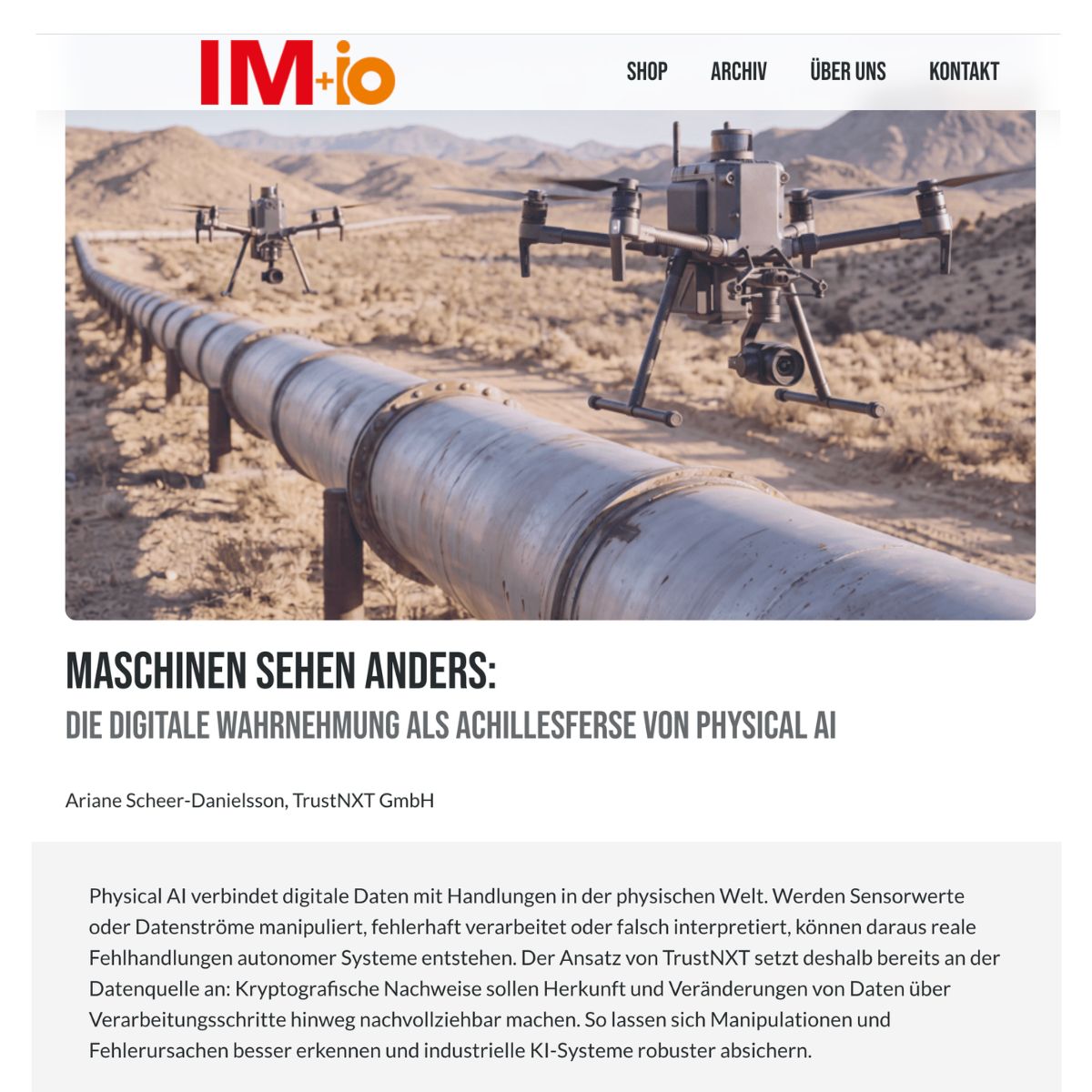
The future of industry is connected and increasingly autonomous. Whether it’s swarms of drones monitoring critical infrastructure or autonomously navigating transport systems (AGVs) in connected intralogistics - “Physical AI” requires an entirely new approach to data validation. We call this technological concept “Mutual Witnessing.” In such a decentralized network, sensors and machines mutually verify each other in real time and cryptographically secure their position and telemetry data via peer-to-peer connections. However, this cryptographic, decentralized trust faces a massive, often overlooked obstacle in practice: the network’s underlying transport layer.
Traditionally, the IT world has relied on the TCP (Transmission Control Protocol) for secure data transmission. TCP excels at guaranteeing data integrity, which is why it forms the backbone of the modern Internet. However, in so-called wide area networks (WANs) or in wireless connections—such as those used by drones or mobile robots - TCP reveals a fatal weakness for real-time systems: head-of-line blocking (HoL). If even a single data packet is lost along the transmission path from node A to node B, TCP’s “stop-and-wait” mechanism kicks in. The protocol forces the entire data stream to come to a standstill until that exact missing packet has been re-requested and successfully received.
For a simple video stream in the office, a brief freeze in the image may be acceptable. In decentralized mesh topologies, however, where networked nodes continuously exchange cryptographic hashes in real time, this freeze is devastating. A tiny, isolated network failure between just two participants leads to cascading errors throughout the entire multi-hop network in TCP. The system suddenly loses synchronization. The fatal consequence is that the system mistakenly interprets the network-induced delay as a physical tampering attempt and triggers a system-wide sabotage alarm.
Scaling decentralized trust in real-world industrial environments relies on the use of modern, hybrid transport protocols such as SRT (Secure Reliable Transport). Such protocols combine the extremely low latency of UDP with fast, error-correcting reliability (Fast-Track ARQ), which is essential for unbroken cryptographic hash chains. The key architectural advantage in a decentralized trust network is what is known as link-level isolation (error isolation at the link level). If a sensor node loses its connection, this problem is resolved strictly locally between the directly involved peers. The rest of the decentralized validation ring continues to operate undisturbed in real time.
True “end-to-end trust” for physical AI requires far more than just strong encryption directly at the sensor. It demands a highly resilient network architecture that mitigates asymmetric latencies and jitter, eliminates cascade effects, and completely prevents “false positives” in tamper detection. Only by modernizing the transport paths can decentralized trust be made suitable for industrial use.