THE CHALLENGE
- Millisecond-Synchronisation
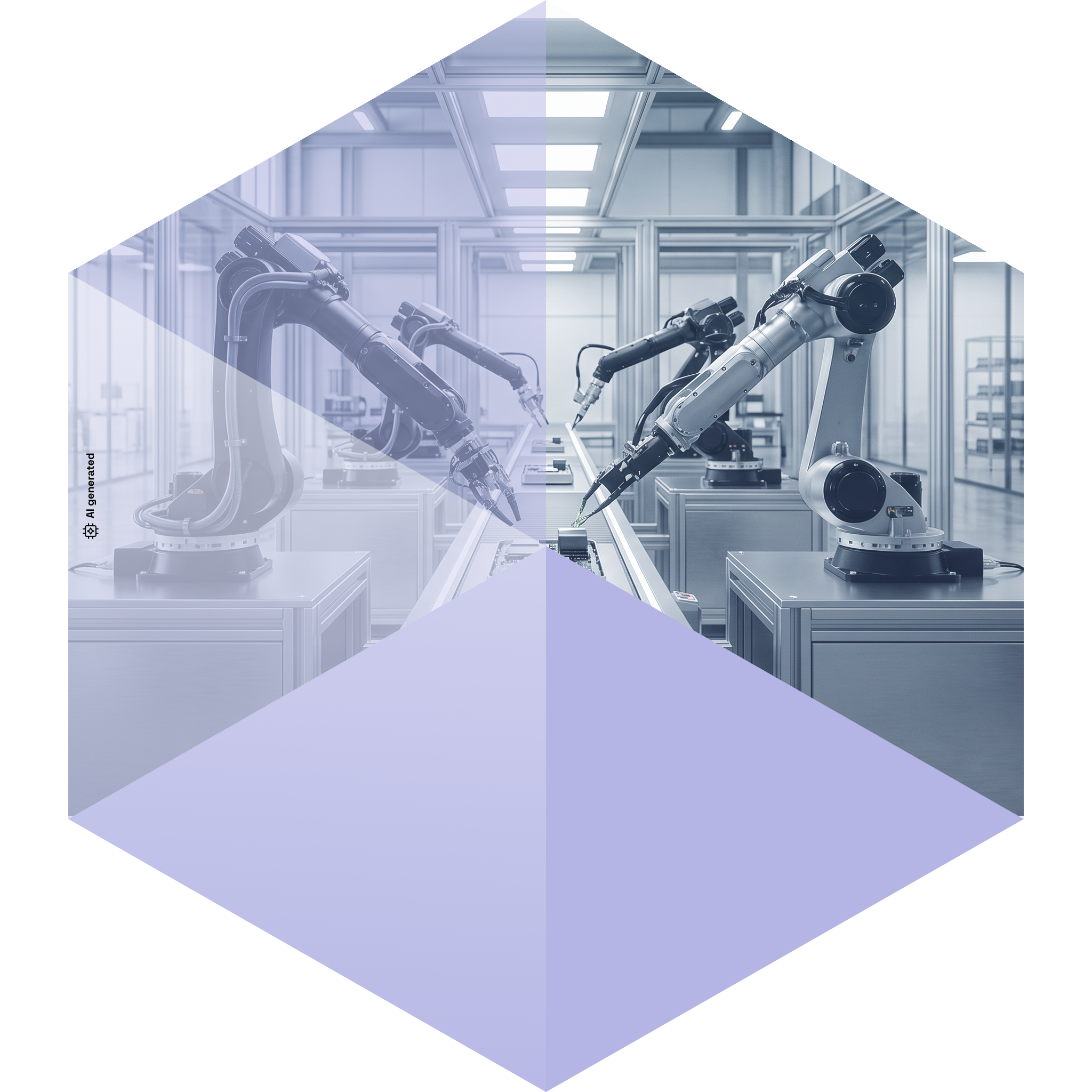
On the assembly line, different types of robots (e.g., heavy-duty arms and humanoids) work side by side on the same workpiece and must synchronize their physical forces with precision. - Destructive Collisions
Even the slightest misalignment or an incorrect isolated sensor reading for Robot B will inevitably cause it to press against Robot A and destroy the workpiece. - Unresolved Liability Issues with Mixed Fleets
If a crash occurs in a fleet consisting of devices from different manufacturers, it is difficult to determine which set of faulty data caused the accident.
THE SOLUTION
- Tamper-proof interface
Before robots perform collaborative tasks (such as releasing a box), they exchange their sensor data and jointly encrypt it. - Data Integrity across Manufacturers
The Secure Interoperability Layer provides both machines with mathematical proof that they are operating with exactly the same, unaltered parameters at the time of the handover. - Automated Consensus
Cross-machine certification serves as a tamper-proof “Cross-Device Notary Service” between robots of different makes.
Measurable added value through cross-machine peer-to-peer verification.

Automated Attribution of System Responsibility
In the event of an incident, collaborative verification precisely documents which robot transmitted incorrect parameters, providing a reliable data foundation for swift warranty resolution.

Conflict-Free Collaboration
The system mathematically ensures that all interconnected machines operate on an identical, verified situational model, virtually eliminating collisions caused by data asynchrony.

Cross-Vendor Scalability
Enables the secure, auditable use of “mixed fleets” without proprietary vendor lock-ins or risky data silos.
How it works
Three steps from isolated sensor data to Data Integrity across Manufacturers.
1

Data exchange in milliseconds.
A heavy-duty industrial robot arm (Robot A) and a smaller collaborative robot (Robot B) exchange their exact position and force data before engaging in physical interaction.
2

Mutual verification.
The machines act as digital witnesses for one another: They validate their local status directly - without going through central servers - using the Mutual Witnessing function.
3

Deterministic interaction.
Only when the network of witnesses provides mathematical evidence that the parameters match perfectly does the physical action take place (e.g., tightening the screw).
Solution Highlights

The Neutral Anchor of Trust
The system acts as a hardware-agnostic trust layer over the machines. Robots from manufacturers A and B do not need an error-prone, centralized control system to be able to trust each other implicitly when collaborating.

Protection Against Sensor Desynchronization
Physical actions are no longer based on potentially asynchronous individual values. Through mutual verification, a jointly verified consensus is established in hard real time.
Seamless SWARM Integration
As a universal adapter, the solution can be integrated directly between the edge computing layer (e.g., NVIDIA) and common robotics middleware (such as ROS 2 or Viam) to immediately secure swarm orchestration.